
Understanding New York's New Pied-a-Terre Tax
As New York State finalizes its 2026–2027 budget, details have emerged regarding the new Pied-à-Terre Tax, aimed at residential properties that are not the owner’s primary residence. Effective July 1, 2026, the new law primarily affects owners of luxury homes, condominiums, and cooperative apartments.
Although the legislation is currently scheduled to sunset in 2031, its implementation will occur in two phases. During the first phase, traditional valuation methods will be used to determine whether a property is subject to the surcharge. Beginning July 1, 2028, Phase Two will introduce a new comparable sales valuation methodology intended to more accurately reflect the market value of certain residential properties.
Who Are Affected?
The new law imposes a surcharge and covers certain “covered properties” that are not a primary residence, which generally fall into two main categories:
● Class One Properties: One to three family residential homes with a value over $5 million, excluding vacant land, and;
● Class Two Properties: Residential co-ops or condo units valued $1 million.
Specifically excluded are Class One or Two properties which have not yet been issued a required certificate of occupancy. The language further accepts residential co-op or condo units subject to an offering plan, but which have not yet been sold or transferred by the sponsor.
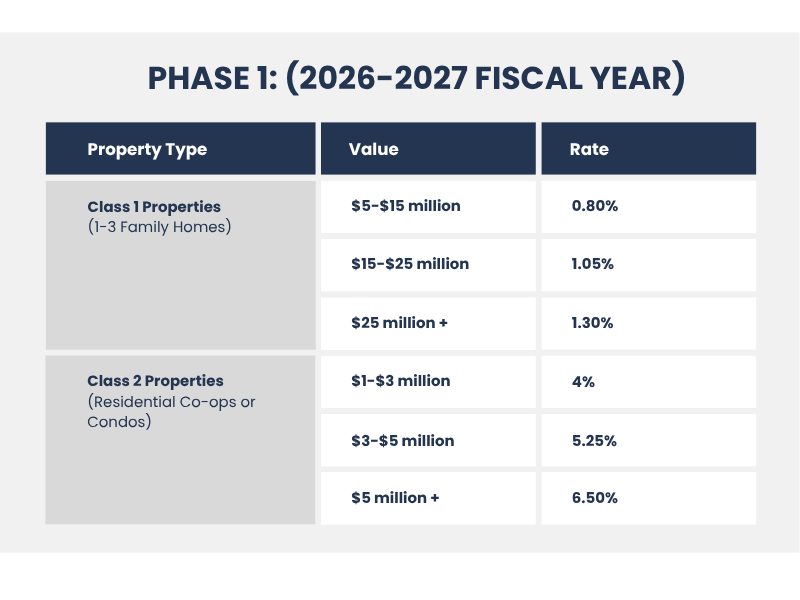
The first phase of the legislation uses existing valuation methods to determine whether a property exceeds the applicable threshold.
During Phase One, Class One properties and condominiums are generally valued using the Department of Finance's assessed market value. Co-Ops rates are based on an “imputed value”, which is simply the total building value prorated based on the percentage of shares owned.
Although surcharge rates for co-ops and condominiums may appear relatively high, these traditional valuation methods have historically under-valued these properties, hence the lower threshold and higher rates. Phase Two seeks to rectify this by shifting the valuation method to use a “comparable sales” approach, and as such, is much simpler:
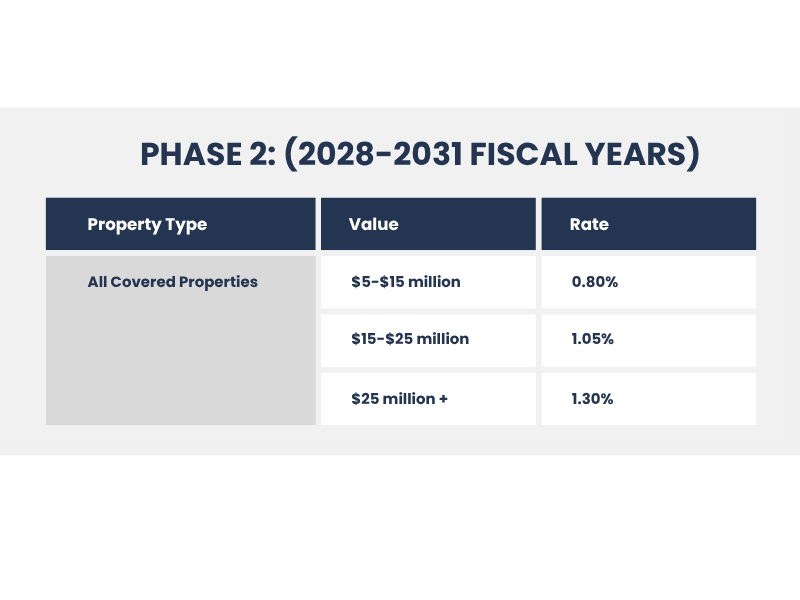
Beginning July 1, 2028, the fundamental shift entering Phase Two is the change to the valuation method for condos and co-ops.
The statutory language is somewhat vague, providing the value to be determined by the Department of Finance provided that the valuation method “considers sales of comparable residential units”. The impact of this change is as-of-yet unclear. By the Comptroller’s estimation, roughly half of all condos and co-ops currently assessed and values above $300,000 may be appraised at less than $5 million under this new methodology, and therefore be exempt, however this number is merely an estimated midpoint.
In addition to the valuation changes, a property is subject to the surcharge only if it is not considered the primary residence of a covered owner. A covered owner generally includes the property's owner or shareholder but may also include certain immediate family members, sole beneficiaries of qualifying trusts, or qualifying long-term lessees under a bona fide, arm's-length lease of at least one year.
The statute grants the Department of Finance broad authority to determine whether a property qualifies as a primary residence. Although occupancy by a covered owner for the majority of the preceding calendar year is one factor identified in the legislation. Other than that, the Department is granted broad discretion to choose the factors required for this determination and require a wide variety of supporting documentation.
Since the question of whether or not a property is a “primary residence” seems to be independent of the owner’s residency status, the Department’s guidelines on making the primary residence determination will be key to navigating this issue going forward. The act specifically authorizes the Department of Finance to require documentation demonstrating that the owner provided the property address on their state resident income tax return. The surcharge is intended to help maintain important city services which presumably the owners of second homes benefit from without properly supporting previous tax schemes; with this in mind, the surcharge will force some property owners to either pay it or face a higher individual income tax liability by declaring New York City residency.
The Comptroller’s report estimates that this new surcharge may raise anywhere from $340 to $500 million from approximately 11,200 properties in the short term. Behavioral changes and market adjustments take time to crystalize, but there are certain to be both long- and short-term shifts in the residential market. While some cities have seen a marked decrease in vacant properties since imposing a similar tax, there may also be a larger chilling effect which discourages certain potential buyers from purchasing properties if they fear they may not be able to meet potentially onerous documentary burdens. In any event, the pied-a-terre tax will continue to be one of the most-watched developments in the real estate space.
The new pied-à-terre tax represents a significant change for New York's real estate market. While the legislation establishes the overall framework, important details—including valuation procedures and primary residence determinations. This will depend on future regulations from the Department of Finance.
Owners, investors, and prospective purchasers of high-value residential properties should stay informed and evaluate how the surcharge may affect future ownership costs and tax planning.
This blog post is intended to provide information generally and to identify general legal requirements. It is not intended as a form of, or as a substitute for legal advice. Such advice should always come from in-house or retained counsel. Moreover, if this post in any way seems to contradict the advice of counsel, counsel’s opinion should control over anything written herein. No attorney-client relationship is implied by this blog.
